Tuesday, 22 October 2013

Kona 2103. So it's NOT about the bike ?

It is said that the race may be lost in the swim and is won on the run. What then is the role of the bike in Iron distance triathlon ?


In the 2013 Ironman Hawaii World Championship we surely glimpsed the critical importance of swimming well enough to leave T1 in the company of the fastest bikers and having the bike fitness and mental discipline to set up the run for success. The bike is the essential platform for triathlon success.  The men's winner had a goal : to be the fastest runner of the fastest bikers. It was an inspired strategy. Frederik Van Lierde combined a 51:02 swim - about 1 minute off the lead swimmer - followed by a 4th-fastest 4:25:37 bike split and concluded with a 4th-fastest 2:51:18 men's marathon to win in 8:12:29.
The day was perfect for cycling with record-low temperatures and ultra-light winds. The swim probably did not split the field due to the absence of Andy Potts and by the halfway point an unusually high number of men remained in the lead group. Out of T1 Andrew Starykowicz (holder of the Ironman bike record of  4:04 at 2012 Ironman Florida) made his intentions known. In all 26 men were within 90 seconds of each other going onto the bike.

By the turnaround at Hawi, however, the persistence of a few key players started to hint at what was to come: Starykowicz was indeed able to hold his lead for the majority of the bike, but Australia’s Luke McKenzie was zeroing in on him, as was Frederik Van Lierde, and Sebastian Kienle. Starykowicz headed into T2 a minute ahead of McKenzie, recording the leading bike split of the day in 4:21:50. Van Lierde was under 4m behind.


They say that sharp elevated spikes in your heart rate are like a book of matches - Yes, you can burn them - but eventually they fade and your book runs out. That was never more true than for Starykowicz leading at T2 but finishing in 21st overall place with a 3.25 marathon. 10m off that marathon time would have almost given him a Kona top 10. It's clear that too much effort on the bike kills the chance of overall success.

McKenzie soon overtaking Starykowicz  held onto his lead until mile 17 of the run when Van Lierde made his move and overtook the Australian to take the title. Commentators noted that Belgian Van Lierde broke through a six-year Australian winning streak as this hard-working competitor benefited from unflinching patience that eventually delivered him into the lead over an incredibly competitive field, making the victory that much sweeter.

"I tried to be smart, and it worked out" he commented . "In the first 30 or 40 km everybody is riding fast, so I knew from the other years to just take it easy and wait. Once we got through 60k I decided to go to the front a little bit more. When Sebastian (Kienle) went to the front I was the one who reacted, and I was with him up to Hawi."

Van Leirde failed to record any fastest splits of the day instead he showed a consistent effort and skill across all three disciplines. The same could be said of Luke MacKenzie - a measured bike performance that saw him run off the bike at 2.40 marathon pace. None of the specialist runners could impact on the day - perhaps too many matches burnt keeping up on a perfect bike day ? Pete Jacobs, the men's 2012 winner turned in a 4.35 bike split - 10m slower than Van Leirde in 2013 - but maybe Pete's slower bike enabled his winning 2.48 marathon ?


What then for the females ?  Marinda Carfrae, the 2010 world champion, turned in one of the best performances distance triathlon has ever witnessed. After, by her standards, a modest swim (58:50), Carfrae echoed Van Leirde by staying close to (but not with) the women's leaders on the bike (4:58:20) and came into transition in 11th place. Leaving T2 with an 8 minute deficit Carfrae set out on the run -and simply crushed the field. The whole field - men or women. She ran the first 13.1 miles in 1:25, surging past Rachel Joyce at the halfway mark on record pace. Not only did she maintain that pace, she got faster, seemingly getting stronger with every mile. Carfrae ran the 13.1-16.4 mile section in a 6:19/mile pace; 19-22.3 mile stretch was done in a 6:25-pace; the final 1.2 miles was covered in just 6:03. And all the while, her stride and form looked liked something out of a running textbook.


Carfrae's 2:50:38 marathon time broke her own women's record in Kona by 1:34, and her overall finishing time of 8:52:14 set a new world championship record, besting four-time winner Chrissie Wellington's mark by 1:48. Her run was the 3rd fastest of the day from either men or women and she actually returned a faster bike split than even Van Leirde.  In short, Carfrae turned in a day that was truly legendary, and among the best the sport has ever seen.

So did Carfrae and Van Leirde's "steady state" approach to the bike establish the platform for their respective wins ? Mark Allen, six time world Ironman champion, speaking to Bob Abbott and Paul huddle on Competitor Radio said..

"It's a closed energy equation so if you're turning Ironman into a bike race you're going to pay a certain price on the run. The challenge then, or the key, is to race it to the point where you still have enough matches left in the box so that you can have the run you need to pull out the victory…"


Kona 2013 makes plain if you are to win "its all about bike....

optimization 
....within the context of the race". 

You can't be left so far behind that the specialist cyclists, with no hope of winning the race, have a time cushion you simply can't overhaul. So while you do need to be an excellent cyclist you must always remember it's not a cycle race. Train hard, have a clear plan, don't get carried away. Cycle steady - keep back those "matches" you need for the run. You might have to cycle harder than you planned to be "in the mix" for the run and that might lower your possible run time - but it still could be enough to send you victorious.

Needing more ?  checkout this analysis of Van Leirde's & Carfrae's 2013 Kona winning bikes from Aerogeeks.Com

Analyzing the bikes under the men’s and women’s champions you see similarities in design but very different execution between the two. Carfrae and Van Leirde both rode UCI illegal frames to victory helping to keep frame manufacturers building frames specifically for triathlon. Both frames had hydration mounted via a rear saddle mount, a BTA setup and a tube mounted bottle (both were using standard bottles on a down\seat tube mount). Van Leirde used deep wheels both front and back while Carfrae appears to have gone with a staggered set. Due to their sponsorship agreements, Carfrae stuck with a mechanical SRAM Red setup while Van Lierde went electronic with Di2.
Regardless of component choices though, both frames propelled their riders to victory. More importantly, people are already saying that the super aero FELT  IA frame may have been one of the major factors in helping Carfrae stay close to the front group in the ride so she could catch them in the run.


Frederik Van Lierde’s Cervelo P5
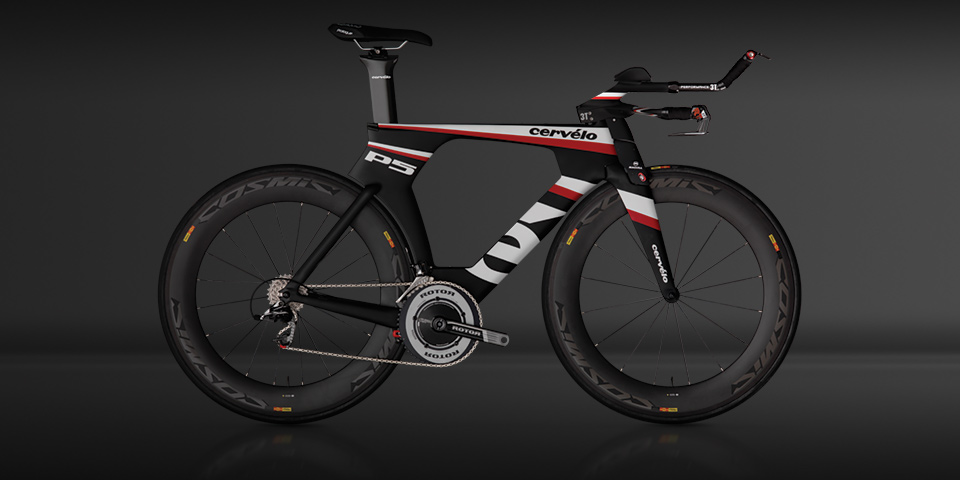
Frame: Cervelo P5 
Wheels: Mavic CXR 80 Tubulars 
Components: Shimano Dura-Ace Di2 9070 
Chain Rings: Osymetric
Rear Hydration: XLAB Delta 200
Saddle: Prologo Nago EVO Tri 40 
Power Meter: SRM 


Mirinda Carfrae’s Felt IA


Frame: Felt IA
Wheels: Zipp 404/808 
Components: SRAM Red 
Rear Hydration: Zip tied cage 
Saddle: Adamo Attack
Power Meter: Quarq


2013's Kona Bike Count ....

As nearly 2,000 of the world’s top Ironman athletes checked their bikes dozens of tri-industry players tallied bikes and components for the annual litmus test of buying trends. After over five hours of counting, Cervelo once again dominated the count, but others are closing the gap.


Bikes
Cervelo – 488
Trek – 220
Specialized – 209
Felt – 115
Scott – 91
Quintana Roo – 80
Cannondale – 79
Argon 18 – 72
BMC – 68
Giant – 66
Kuota – 53


Interesting 2013 Kona Facts courtesy of Competitor.Com ...

  • In 2012, 109 athletes finished in under 9:30. In 2013, it was 251.
  • Milos Kostic won his 7th consecutive Ironman World Championship title in the men’s 70-74 category. The Canadian went 12:03:38, continuing his unbeaten streak on the island.
  • Canada’s Beverly Watson won the women’s 60-64 division thanks to an 11:50:41.
  • Great Britain’s Catherine Faux had a blazing 9:15:16 in the women’s 25-29 age group, which made her the fastest age group women of the day.
  • Master chef Gordon Ramsay exchanged his fiery kitchen for the lava fields in his quest to become an Ironman. In his first attempt at the distance, Ramsay put together a 1:21:20 swim split, pedaled to a 6:35:54 bike and paced out the marathon in 5:48:31 for a 14:04:48 clocking.
  • Mexico’s Luis Alvarez successfully completed his 100th Ironman race in 15:54. Alvarez completed his milestone race just a few minutes after Ironman’s first champion completed the race 35 years after he became the world’s first Ironman athlete.
  • 78-year-old Harriet Anderson finished more than 3 minutes to spare.
  • The men’s course record is 8:03:56, held by Craig Alexander.Alexander was the oldest winner in the race’s history when he set the record two years ago at the age of 38.
  • Wetsuits are illegal in the swim, giving stronger swimmers an advantage over slower ones.
  • The historical high air temperature in Kona on Oct. 12, the date of the 2013 race, is 92 degrees.
  • The average high temp in Kona on race day is just 84 degrees.
  • Black asphalt and lava rock absorb heat from the sun and radiate it back upward, effectively elevating temperature well beyond the measured air temperature. Triathlete staff recorded a temperature of 109 degrees at the blacktop on a day in July 2010 with a reported high in the mid-80s.
  • It took Chris McCormack six tries to finally win his first Ironman world title in 2007, 10 years after he won the ITU world championship.
  • The Ironman bike split record is held by American Andrew Starykowicz, who will be making his Kona debut this year. He rode 4:04 at Ironman Florida in 2012. That’s 27.5 mph.
  • Inside Triathlon conducted a test to measure the aerodynamic benefit gained by a person riding the legal distance behind another athlete, which is 10 meters for the professionals. This test found that an athlete traveling at the average speed held by the top men can save 12 watts while staying within the rules.
  • Brett Sutton is considered by many to be the most successful triathlon coach of all time, having guided athletes including Chrissie Wellington, Siri Lindley, Nicola Spirig and others to world titles or Olympic gold medals. His athletes racing Ironman Hawaii in 2013 are Jodie Swallow, Caroline Steffen, Mary Beth Ellis, David Dellow and James Cunnama.
  • Deydration and electrolyte depletion are not associated with muscle cramping, according to many studies on distance runners and a 2005 study conducted on Ironman triathletes.
  • Eight-time Ironman world champ Paula Newby-Fraser was leading the race in 1995 until she collapsed on Hualalai Road, just 500 meters from the finish.
  • Iron War, the 1989 battle between Mark Allen and Dave Scott that has become the most celebrated head-to-head race in Ironman history, was settled when Allen dropped Scott on a small rise at mile 23.5 after the pair raced side by side for 138 miles. That small rise is now known as Mark and Dave Hill.
  • ABC’s “Wild World of Sports” captured Julie Moss’ 1982 collapse just meters from the finish. That spot is behind the current finish line because the event used to finish on the Kona Pier, where transition is currently located. Footage of her struggling to finish helped propel the growth of the sport.
  • Since Normann Stadler did it in 2006, no male has won the race after coming off the bike with a lead over the rest of the field.
  • Average finish time in the last four years, according to Runtri.com: 11:32 (2012), 11:25 (2011), 11:14 (2010), 11:37 (2009)
  • The average age of the registered male athletes is 42, and the average for females is 40.
  • Training Peaks reports that Faris Al-Sultan’s 2012 peak 30-minute power output of 308 watts is enough to power a flat-screen TV.
  • Riding with a power meter allows athletes to accurately gauge their caloric expenditure on the bike. Training Peaks software calculates that most of the top men consume 4,500–5,000 calories on the bike alone and the women typical use about 3,000–3,500.
  • 2012 Kona champion Pete Jacobs’ power data shows he rarely went “into the red” during the bike. His power file on Triainingpeaks.com shows several spikes above his threshold power (what he could hold for one hour), but they are for such short duration (15 to 30 seconds) that they don’t count as “matches,” a term that power analysts use to describe hard, sustained efforts that will tire a rider over time. Sustaining a fairly consistent effort level on the bike helped him run his way to the title.
  • Participants typically lose 3-5% of their body weight during Ironman Hawaii.
  • American Andy Potts has been first out of the water every year since he first came to Kona in 2008, and usually by a sizeable margin. He is yet to survive at the front of the bike pack all the way back to transition, losing between 8 and 12 minutes to the main contenders in each of those five races. 2012 was his best ride to date—he gave up eight minutes to eventual champ Pete Jacobs.
  • When the sun sets, athletes still on the course are given glow sticks to stay visible in the darkness.
  • In case of a mechanical problem, both the male and female pros will have one neutral support car driving closely behind the race to provide assistance. Aid from the support car typically doesn’t come immediately, however, so punctures or breakdowns still result in lost time.
  • Age-groupers are on their own for mechanicals. Not only does the race not provide official support, but receiving support of any kind results in disqualification.
  • Considering the quality of the field, finishing rates are quite high despite the tough conditions in Hawaii. Last year there were 1,883 finishers, and a 4.9 percent DNF rate.
  • The five most common med tent visits in Kona: dehydration/exhaustion, GI issues, cramping, blisters, minor injuries (road rash, contusions, ankle sprains, etc.).
  • Athletes can make it to Ironman Hawaii in four different ways. Qualifying at Ironman or select Ironman 70.3 races is how most people punch their ticket. Other routes include the Ironman Lottery and Legacy programs, winning one of the eBay auctions for the (very expensive) charity-donation slots or being invited by Ironman for promotional reasons such as celebrities and Kona Inspired athletes.

Monday, 16 July 2012

Dynamic Stretches - If I can You can

Dynamic stretching before excercize is recommended by British Triathlon. It’s used by coach Bobby MacGee within a workout after the low intensity stuff and before intense intervals. Jack Daniels suggests stretching after first elevating the temperature of the muscles involved in the workout. Tim Noakes (Lore of Running) puts it like this ..


The particular physiological effects of warming up are to increase respiration and circulation, especially to the active muscles ; to increase the temperature of the muscles; and to reduce their viscosity, thereby increasing their flexibility…. muscles that have warmed up are more resistant to tearing.”  


Pre race Noakes writes .. 
“Stretching is essential to overcome the overnight tightness and inflexibility that will have developed in your most-trained muscles – the calves, hamstrings and back muscles. Set aside 15 minutes for this.”


According to the April 2010 edition of Running Times …

A DYNAMIC APPROACH

"The dynamic warm-up piece is truly like turning a light switch on before walking into a dark room," contends Reiff. Dynamic stretches that include quick-paced movements like bounding, jumping, and single-leg swings help to fire up the muscles that you want to perform. To implement a dynamic warm-up routine, Reiff suggests choosing a set of exercises you will remain committed to and practice before every run and race. The routine described at the right can be done in 10 minutes.

While static stretching remains a good post-run ritual, the research and applied evidence touts the many advantages of engaging in a dynamic routine in its place. Says Reiff, "Dynamic stretching recruits more of the body than static stretching. We certainly don't throw away static stretching, but it has its place. For pre-race and pre-training, dynamic flexibility and movement has a much better return on the investment." Reiff recommends performing the exercises before every regular run. Prior to hard workouts and races it tends to work best to do a warm-up jog and then perform the dynamic stretches, followed by strides. This helps to adequately warm up the muscles and then get the right ones firing in the right ways.

Reiff adds, "If you can train athletes on a daily basis to fire those muscles appropriately and go through a dynamic warm-up that ensures that all muscle groups are worked, then you have a better runner."


It seems maybe I'm the last person (male ?) left who hasn't been doing this. But since London I certainly am now. My recommendation for an enjoyable run-specific 10 min warm up is below ... By all means download the MP3 file here. Add it to the start of your run playlist and enjoy.  


DareToTriLife Dynamic Workout Menu (10mins) ...

  1. Start with a two minute jog at a really easy pace. 
  2. Heel walks for 30 seconds. 
  3. 
Shoulder and arm rolls for 30 seconds.
  4. Side Bends.
  5. Hip swivels.
  6. Hulahoop hips.
  7. 
Lunges. 
  8. Hamstring stepovers. 
  9. 
Knee hugs. 
  10. 
Butt kicks. 
  11. 
Hamstring Kickouts 
  12. 
Run back to you start point at half marathon pace.

The clips below show great examples of how to do these ...


Sunday, 20 May 2012

Sweet Potatoes - Dare to Tri ?

If sweet potatoes are not a part of your triathlon, running or workout life then you are missing out. Faster to prepare than our common British (white) potato these guys are brimming with more great Vits and nutrients. Here's the skinny on Sweet Potatoes ...


  1. Lower GI than white potatoes = more constant energy release (30% less of a blood sugar spike !)
  2. Higher soluble fibre
  3. Sweet potatoes are rich in carotenoids eg. beta-carotene. Accoring to this source beta-carotene can assist in reducing breast cancer risk : here.
  4. You'll get more potassium from a sweet potato than a banana !
  5. Centre for Science in the Public Interest (here) scored Sweet Potato as No1 for overall nutrition - ahead of the Superfoods : kale, broccoli and spinach.
  6. Peel, boil for 15m, mash with organic butter .... it's done. Need more ? Try here.
Yes, but are they Paleo ? (Need to know more about the Paleo Diet ? check here) According to Robb Wolf (here) they have their place....

The popularity of the sweet spud has sky-rocketed among the paleo community. It’s commonly associated with the term “safe starch” and is a powerhouse post workout meal when paired with some protein.

Mark Sisson wrote :

“Evidence exists for human consumption of roots and tubers from multiple sites spanning multiple time periods: Northern Europe (specifically Poland), in the terminal Paleolithic and early Mesolithic. Clearly, we have the physiology (amylase production, glucose metabolism), the tools (fire, hearths, digging implements), and the motivation (attraction to dense caloric sources with negligible or easily neutralized anti-nutrients) to consume starchy tubers.”

.... and with sweet potatos there's none of that Nightshade family stuff (glucoalkaloids) to worry about. Check this out from paleohacks.com ....


 A lot of Paleotypes like to be low carb and that makes any potato a problem (more on this here). I like the fact that they are linked so much to an active lifestyle - where you need the energy. Anyway what clinches it for me is Sweet Potato fries. I first had these recommended to me on a trip back to Vancouver - they are excellent. You need to try this ...


So add Sweet Potato to your diet weekly and make like the guy in the clip - do a workout (or stretch) for the 20m these are in the oven - and remember to grill to crisp off. Enjoy

Tuesday, 24 April 2012

Injury, Context and the London Marathon 2012

Marathon training week 14 followed the longest run of the programme (38k) and in truth I was tired - if excited - with how things had gone. It was over 100k of running last week (clue 1). The highlight of this week was a tempo run of 13.5k completed at marathon pace i.e. 4m16s per km. That went great. Delighted. So Sunday's long run rolled around and long was now redefined as 16miles - not 23 ! I loved this new definition of long. Rather than "Long and Slow" I thought I'd try and keep the 5k "sets" of the 26k run around marathon pace - and, as you never do anything for the 1st time on race day, I swapped my supportive Brooks Addictions out and brought in the lighter Brooks Adrenaline shoes I usually race in. I've had these shoes for over 3 years now (clue 2) and used them in Paris and Barcelona - as well as various triathlon runs. The idea here is to train in heavy, protective but clumpy shoes and then feel all "light and airy" on race day with shoes a few 100g lighter. I guess the other looming factor here is my arrogant attitude to strength, conditioning and flexibility. I might be 46, have far less cross training than in previous years but I'm invincible - didn't you know ? It happened right here ....

The Loch Creran 10k Loop - the scene for 70% of my training
  ... after  3 sets of 5k splits close to 4.20 pace - with hydration, electrolyte and gel consumption going perfectly. At 15k of this run there was nothing but a sense of wellbeing by 15.75k there was a sudden growling deep fatigue in the right lower leg and while not the "gun shot" of a calf tear it had almost the same sense of "doom". My leg had 6 weeks written all over it. I limped back to the car.

Legs are complicated things when you look into it. But the things you can do when you have a problem are limited : Ice it, Warm it, Ibuprofen dose it, Rest it, Massage it, Ultrasound it. Not getting the injury in the first place seems by far the best option. My GP suggested I call the physiotherapy dept of the local hospital. They thought the 1st 3 of my list would be enough & "No" they didn't want to see the leg in question. I began to look into how to postpone the marathon place until 2013 and London let you move your spot to next year right up to the day before the race - which I thought was generous. It meant the final decision could be days away. I waited until Thursday before running again. It was 2k before the pain came back and now I'm almost certain I can't run London.

Out with the Old ...
You have to remember what we all invest in this process - 1100k run since 1 Nov 2011 - to get to that exact spot on Loch Creran where unsupportive & maybe too old shoes, combine with high mileage fatigue and way too tight calf muscles to say - enough ! But the accommodation's booked, flight's are booked, there's loads of people coming - it's taken 5 years and 6 attempts to get this entry and - most frustrating I think I'm in the running form of my life. If I had run just 4 more km the previous weekend it would have been a marathon PB ! The layers of disappointment are heavy and the mood that week was gloomy and appallingly self-absorbed. I'm sorry to Dearly Beloved and work colleagues. The sense of loss seemed dreadful. So much for it being about the journey then.

On Saturday I note the ad for Achilles Heel sports physiotherapy (here), on the web - they have a cancellation and on Sunday I meet Jenny. Jenny got me through the London Marathon. Jenny firmly points out the tightness of the hamstrings and calves, she confirms that the strain is internal (somewhere around 5 or 9 in the diagram), it's probably been an overpronation caused by the less supportive shoes - but in combination with mileage and lack of flexibility. She makes me do some of the stretches I should have been doing for weeks & we're both encouraged by the "intrinsic" strength of the calf. I met Jenny in anticipation of her confirming I should withdraw from the race but she re-lit the flame of possibility. Do no running until the race (that means no real running in the 2 weeks before), redefine your goals, undergo a loosening sports massage, expect it to hurt in the latter miles and have a plan for that. Game on. Note to self : if you have a sports injury see a sports physio. Pay what it takes and do that as soon as you can. A hospital physio is interested in stopping your pain - a sports physio is interested in getting you back to your sport.

‘A good traveller has no fixed plans, and is not intent on arriving.~Lao Tzu

The 2 weeks from injury to race was an opportunity to reflect just how much this campaign meant to me & why. There's a form of addiction to exercize that is covered in an article by Active. Com here. I don't think this fully applies here but triathletes are often classically Type A personalities and probably don't deal too well with disappointments. It was supposed to be about the journey, keeping fitness through the dark Argyll winter, the family gathering, sharing some memorable time across 4 generations. For sure I got the balance wrong for a while. To be honest f I run 3.02.59 or 4.45.59 the sun is rising in the east tomorrow regardless. Learn John, Learn. The issue here was probably 90% flexibility. Tim Noakes writing in "Lore of Running" sums this up nicely ...

"Stretching is not something that most runners do willingly. Runners who somehow manage to squeeze in 1 or 2 hours running a day never seem quite able to find the additional 5 to 10 minutes for adequate stretching. There are a variety of reasons for this. First, most inflexible runners are unconvinced that stretching is beneficial. Secondly we are ignorant of what is involved. Third, experience has taught us that stretching hurts ; and finally, we are haunted by the suspicion that we may be doing it wrong anyway."    
London Water Tower - amazing self-catering accommodation close to race start.
Our accommodation was a little special. The London WaterTower (here) was chosen by my son & I way back last year - designed to be a venue that we'd remember. It certainly was. 5 bedrooms with an observatory at the top of the tower from which the London skyline at night was simply astonishing.

Dusk from the Tower

Looking towards Canary Wharf from the Tower
Canary Wharf, the neon blue of the London Eye, the Shard, the Dome - aircraft landing in 3 directions. The Tower is close to Woolwich and on Shooter's Hill Rd, which is the route for the marathon Blue and Green starts. It was an easy 2 mile downhill walk to Blackheath on race morning.

Mum & Rachel - in "The Tower"

First though there was registration and that took place at London's EXCEL - the scale of the event became clear the moment you walked in.


The place was enormous with all the major apparel, nutrition, equipment and charities represented. That 2012 is Olympic year gave 2 themes to most suppliers. The Expo was world-class and on Saturday my Mum and I ate the pasta and watched Scott Overall (UK's only male to reach an Olympic qualifying time) give a presentation then watched in awe as the staff from Virgin Active Clubs gave a fantastic workout demonstration. Other demonstrations included Runner's World and Martin Yelling.
Guide Dog Puppy in Training - a lot like Tilly
This really set the tone. Loads of freebees, samples and every stand had a deal - Stephen (or Hazel) resisted the 10% off the 910XT ! The Buzz was amazing as 37.5k runners registered from Weds-Sat. Jenny's taping was somewhat the worse for wear by Friday so the guys at KT tape have me a man-shave and re-taped the offending leg. So one re-taped leg of unknown condition. I think it was a little weird to be part of this amazing event and not actually know if I was physically able to run the thing - but at least I was trying to control all the stuff in my gift to control. Also the news from Chrissie Wellington was not good. Chrissie had .... a sore toe !


It was a highlight to be in the same race as "the Chrissanater" - but sadly she had no opportunity to take her toe to Jenny in Achilles Heel, Glasgow so Chrissie DNS. John's Leg : 1 Chrissie's Toe : 0.


The London marathon is the single largest fundraising event in the world and people go to extreme lengths for their chosen charity.....

I actually saw this on the course .... but was it ahead or behind ?

.... what I was not aware of was the support on the course from the charity to the runner. A single charity would have a group of 8/9 people watching for runners wearing their raceday tops and callout their names wildly - invariably causing the supporters around to roar in agreement. That would have been so encouraging. Also some charities laid on post-race receptions for their athletes. See what I mean about world class ? If you run - you should make this race an ambition. On Saturday I took the leg out on a short run through Woolwich Common. This was a running break of 10 days and 6 days since Jenny's massage. It was fine after the full 5k and that was very encouraging. That was the final moment to decide - withdraw today or run tomorrow come what may. Ok I felt "fat", stale and heavy but the leg worked and was not painful. Green for Go.


Race day. Need to leave the Tower for about 07:15. The London transport system is largely free if you flash your race number - but I can walk (to the start at least).  Forecast very good - cold but sunny ; elect to wear just the Team Dylan  "Running for Sarah" singlet and shorts. Have chip on shoes and gels in the race belt ready to go. Breakfast was salmon, avocado and sweet potato ...


Local roads closed at 06:00h and already marshalls are in place. Knew I was in the right direction not just by the blimps signaling Red, Green and Blue starts but by 2 guys in a bobsleigh looking like a sporty episode of the Flintstones.
The balloons at Blackheath
 
Everything was easy, everything was clear and obvious, there were an infinity of staff and the organization perfect. Once "let into" the Blue zone the huge screen kept us amused, there were changing tents, portaloo's, free tea and coffee, free sports drink, water - even urinals to speed things up. This is what I saw opposite me in the urinal ....


... which is an image you are not likely to forget. At that moment you knew you were in the London Marathon. I kept warm with tea, lots of layers and was actually quite philosophic about the old leg. Who knows what will happen - best hope is to run 30k "within oneself" and take it from there. I had no idea at what point I would know I could complete the distance by walking - certainly not 10k, probably not 20k, 25k ? I got some sports drink and black tea and set about "hydrating" in front of the huge video screen.


This kept us informed of the woman's elite start & interviews with several athletes within the Blue Start group passed the time quickly. Before long it was time to disrobe, take our belongings to the fleet of trucks which would transport them to the finish. It was almost time. I assembled with the other runners and we packed our way towards the start line. Elite men were ahead of us but we started at the same time (cheering) and it took just under a minute to cross the timing mat.

Want to pickup on some raceday atmosphere ? Then click on the button below as you read on ... Note that I'm wearing my Team Dylan "Running for Sarah" Singet - so see how many times you can catch a call of "go Running for Sarah" from the crowd ... that was quite emotional.

Blue Start - Image from Guardian Website

There were a lot of people and not much space so the early km were congested and necessarily slow. I wasn't personally worried as I felt this was a good "break" on an early stress to the injury. In fact the first 5k took 23m.32s  - which was getting on for 2m less than my ideal. The route took the Shooter's Hill road back towards our Tower for the 1st mile then turned towards Woolwich. we passed the venue for the Olympic shooting competition - which we had seen on our many no 178 bus journeys over the few days.
Elite Men run outside the Olympic Shooting Village - Guardian website.

Leg going well and the 2nd 5km feels more "normal" - the "WOW" being the turn into Cutty Sark as we approach Grenwich. The ship comes quite unexpectedly and is utterly beautiful - but the Crowd are what make it just amazing. The noise and intimacy are something you will never forget. It genuinely made me gasp & you smile a smile wider than you could imagine.


Some parts of the course are through borough high streets, some through more residential areas but everywhere there are people cheering and encouraging. I had no idea it would be like this. Almost the whole 26miles was one high-octane, emotionally-positive wave of super-charged goodwill - from perfect strangers I will never see again. For me the star of the day was overwhelmingly the London crowd - they were inspiring and uplifting. They are the reason you need to do this race. Usain Bolt or Wayne Rooney probably pull this crowd every athletic day of their lives - I tasted their experience on 22nd April 2012.

2 Time London Champion Irina Mititenko on Tower Bridge

The first glimpse of Tower Bridge (12miles) has double meaning - it's astonishing in it's own right and it somehow proves you're doing this for real. But it's not quite half way and once you cross the bridge you turn away from the Tower of London & start to run AWAY from the finish line towards Canary Wharf and the Isles of Dogs. With 14 miles to go the reality is that the distance is only just about to express itself.


The splits table shows that my pace to the half way mark was only just off where I needed to be for my original goal - maybe just 5-10s per km. But this was nice conservative running and I thought I was keeping options open for later. Also the water, gel, sports drink sequence was working fine so nutritionally I was in good shape.

The race changed for me from 25k - both legs seemed to feel gradually heavier - actually "thicker" more than heavy - if that makes any sense. It wasn't all that perceptable to start - just the pace didn't feel "right" and it seemed to be taking more effort. I notice that it took 20s more per km for more or less the same heart rate in the 25-30k split compared to the 15-25k splits. Not a good sign. I have a sensation that my muscles were becoming somehow less flexible - but can't be sure. The route into the Isle of Dogs is partly "out and back" so I had a glimpse of elite ladies as they passed back towards Parliment Square. But the mood was getting gloomy and the crowd was thinning. Something seemed wrong.

In training I'd picked up a phrase from Brett at the "Zen and the Art of Triathlon" Podcast here - "mood is food". By which he's making a connection between your blood sugar level and your feeling of wellbeing. I think the idea is that muscle glycogen might be fine but "free" glycogen "burnt" by the brain (in the blood stream) might be in short supply & so you get mentally stressed and slow down while your actual legs have performance still to give - but sadly they don't get to use it. So keeping well fuelled is critical to the mental management of the race. I tried to stock up on the Lucozade sports drink on offer through the Canary Wharf aid stations. To be honest I find that drink way too sweet and much prefer Gatorade - but I had been practising with Lucozade so that should have been fine. A bit spluttery here and there and next time I want to be fast walking through these latter aid stations to make sure I get the benefit. It seemed a grind - I don't think I was losing position though.

Coming back towards the Embankment with 10k left there was a sense that this would now finish and while the time was not what I wanted - I would at least complete the course. You start to pass the other athletes running in the opposite direction on their way into Canary Wharf and there was the nurse ...


.... poor nurse. She was probably still 8k behind me. It happened at the Tower of London. The slower run rate suddenly became cramping. Not the light "fluttery" cramps of Ironman Canada but "you mess with me I'll take your leg out" cramps. A calf-cramp like that is not optional - it seizes you. Overwhelms you. Bit like this really ...

Alien in your tummy ? A lot like calf-cramp in a marathon.
So there I was ... London marathon and all. Looking for a PB, family out there somewhere - and yet I'm clinging to railing outside the Tower Of London. Honestly - this is not in the script. It's not even the same leg as was injured 2 weeks ago. It's the left leg. The OTHER leg. My "best friend" leg. I'm clinging to this railing in front of a million people (it seems like) - while the world runs by ... my position is fading like the equally cruel escalation of numbers dancing across your petrol pump !

Railings on the Tower of London - I'm not even a Sufferette !!
Now cramp is a big deal & I've had it before - just NEVER when running. There actually was a person being treated by the St John's folk right in front of where I was stretching - which was a nice bonding experience. The Mid Argyll Tri & Cycle group are suggesting that I was physiologically and sub-consciously sparing my "injured leg" and overly using the other. I have no idea. Maybe. They also suggest I could train a bit better - ouch ! Whichever (or both) there's a great review article on cramping (bike orientated) here. All I know now is that that John Hurt's little Pal from the movies is running up and down inside my lower left leg. You won't believe this bit but a Marshall walks towards me as I'm gently cornering the alien behind some bit of tendon and she says "That lady says try this ...". She points into the crowd. Try what ? I'm offered a small spray bottle by the Marshall - I look into the crowd and someone about 3 people deep back leans over and waves. Honesty she looked like Sopia Loren with a scarf & sunglasses.


I know this sounds like the start of an urban myth that ends in an ice bath with one less kidney - but, "Trusting of Argyll", without any hesitation, sprays the stuff under his tongue. And it works. The human sea behind me flows endlessly like wildebeest across the plain but gradually the alien in my leg seems to be shrinking. Much later, back home & much relieved, I find there really is a product that actually exists for this purpose : Cramp Stop (here). It's a NZ homoeopathic medicine and the reviews seem good. Certainly & almost right away I was able to walk & I would recommend a trial of this product to those with a history of cramping issues. But walking was all I was prepared to do - running seemed high risk and anyway by now the PB had packed it's bags, unhitched the mule and headed west into the setting sun. Just under 7k - left. If I can walk this I can still finish.
That 7k was amazing. You can hear it if you clicked the player button above. The crowd were amazing, simply amazing. So supportive and so encouraging. I will never think of London as unfriendly or impersonal ever again. Of course I was passed by an infinity of people and several tried to coax me into running. One lady was in a mentally gloomy place and we talked as we walked - at that moment she thought she wouldn't ever do another one .... but I bet she didn't feel that way as she finished. She wished me well has she jogged off.  Bands played, horns blared and the sun shone. All along the embankment the support was breathtaking. If you ever ever thought of running a marathon - please do not hesitate. Get a charity place, raise the funds, prepare and train. Just DO THIS RACE. I don't care what time you finish in 3,4,5 or 6 hours - just do it. It is a life memory you will never regret. The privilege of running along the embankment, by the Mother of Parliaments and towards Buckingham Palace is something I will treasure. My walks and occasional trots gave the crowd time to read the text on my running top : "Running for Sarah". This was a NIHCS fundraiser from last Sept's Great Scottish Run & the frequent shouts of Sarah's name from complete strangers were emotional and motivating. I'm sure she was looking down that morning and getting a real buzz from the overwhelming support.

If you run for a charity chances are that along the route they will have supporters looking out for you. When you run past they roar your name and the boost it gave runners was instantaneous. Several then had receptions for their athletes - which included massages - just off the finishing chutes. With about a mile to go and 25mile in I began to be passed by some of the faster folks in costume - a 5ft Bee, Cat Woman, a Monk. But the largest cheer (you can hear it on the audio) was for a guy in a Mankini ... 


... let me assure you - you don't ever want to be passed by a bloke in a mankini !! There is no good view of that. But the crowd loved it and he seemed to be having a terrific day. I ended up with sun-burnt shoulders - wonder how he was on Monday....

The turn into the Mall and the final 385 yards was a fabulous setting. If you've seen it on TV you'll already know it was wonderful just to be a part of it. I do have to say that it almost felt like cheating to walk/jog that final few meters. It should have felt awful, gut-wrenching, the burn of lactic acid, the ache of spent muscles, the absolute joy of knowing you left absolutely nothing back on the course - you gave the race simply everything. Reality was that in the last hour I'd essentially had a recovery walk while all around me were slogging their way to the line. So yes : a finish but really I have to do it "properly" some another time. The organization was as slick as you'd expect - chips off, medals on. A scientific study of cardiac fatigue. The immediate memory of finishing was a French chap crying his eyes out by the fence. I stayed with him for a few moments and he seemed to regain some composure - the emotional depth of why some people do marathons & what they have invested of themselves can be quite profound. I wonder what this person's story was ...


So what about this as an event ? OK I got through it & have the medal to prove it. But athletically it did not go to script & I don't feel I did the race justice. 3h48m & change was the 3rd fastest time for me over this distance and quite honestly was a disappointment. However if I was offered 3.48 right now given all the great stuff we did - I'll take your arm off. Definitely worth doing. I should mention Claire Squires tragic death and how she captured the imagination here and here. I bet most runners donated & how the news spread is a testimony to social media.

Dinner in "The Tower" - Thurs evening

Planet Hollywood - Piccadilly Circus : Post Race

Champagne & Caviar - Harrods - just don't buy any water !

"Sir Alan's Cafe" ... very good it was too !
Post Race "Top End Sports Nutrition" - a la Rachel !!!

Travel condenses experience and gives a new perspective. It inspires, bonds friendships and is deeply refreshing ..

 “Twenty years from now you will be more disappointed by the things you didn’t do than by the ones you did do. So throw off the bowlines, sail away from the safe harbor. Catch the trade winds in your sails. Explore. Dream. Discover.” – Mark Twain

... on this trip I experienced .... a major F1 type sprint to drop off beloved Tilly, Beazley and Squill in a wonderful pets boarding-home full of peacocks (but no staff !!!), enjoyed a world class athletic event, stayed in a fantastic location, became all too aware of many of my own bio-mechanical shortcomings, took my Mum to a pasta party ar  Excel, know how to navigate from Shooter's Hill to Woolwich 3 different ways, got the best view of Cutty Sark ever, know that my brother-in-law gets lost easily on public transport, have become deeply appreciative of the London public, enjoyed a family night at the theatre, got sprayed under the tongue by Sophia Loren, now know that Champagne is better value for money than Scottish water in Harrods, was amazed to find how much Rachel loved the Imperial War Museum, had an amazing coffee in the Natural History Museum, know that I was right to apply for this event 6 times, am still amazed by the durability of my mother and am even now deeply impressed that Hanna running up the stairs can beat her mother in the lift !