Showing posts with label running. Show all posts

Monday, 16 July 2012

Dynamic Stretches - If I can You can

Dynamic stretching before excercize is recommended by British Triathlon. It’s used by coach Bobby MacGee within a workout after the low intensity stuff and before intense intervals. Jack Daniels suggests stretching after first elevating the temperature of the muscles involved in the workout. Tim Noakes (Lore of Running) puts it like this ..


The particular physiological effects of warming up are to increase respiration and circulation, especially to the active muscles ; to increase the temperature of the muscles; and to reduce their viscosity, thereby increasing their flexibility…. muscles that have warmed up are more resistant to tearing.”  


Pre race Noakes writes .. 
“Stretching is essential to overcome the overnight tightness and inflexibility that will have developed in your most-trained muscles – the calves, hamstrings and back muscles. Set aside 15 minutes for this.”


According to the April 2010 edition of Running Times …

A DYNAMIC APPROACH

"The dynamic warm-up piece is truly like turning a light switch on before walking into a dark room," contends Reiff. Dynamic stretches that include quick-paced movements like bounding, jumping, and single-leg swings help to fire up the muscles that you want to perform. To implement a dynamic warm-up routine, Reiff suggests choosing a set of exercises you will remain committed to and practice before every run and race. The routine described at the right can be done in 10 minutes.

While static stretching remains a good post-run ritual, the research and applied evidence touts the many advantages of engaging in a dynamic routine in its place. Says Reiff, "Dynamic stretching recruits more of the body than static stretching. We certainly don't throw away static stretching, but it has its place. For pre-race and pre-training, dynamic flexibility and movement has a much better return on the investment." Reiff recommends performing the exercises before every regular run. Prior to hard workouts and races it tends to work best to do a warm-up jog and then perform the dynamic stretches, followed by strides. This helps to adequately warm up the muscles and then get the right ones firing in the right ways.

Reiff adds, "If you can train athletes on a daily basis to fire those muscles appropriately and go through a dynamic warm-up that ensures that all muscle groups are worked, then you have a better runner."


It seems maybe I'm the last person (male ?) left who hasn't been doing this. But since London I certainly am now. My recommendation for an enjoyable run-specific 10 min warm up is below ... By all means download the MP3 file here. Add it to the start of your run playlist and enjoy.  


DareToTriLife Dynamic Workout Menu (10mins) ...

  1. Start with a two minute jog at a really easy pace. 
  2. Heel walks for 30 seconds. 
  3. 
Shoulder and arm rolls for 30 seconds.
  4. Side Bends.
  5. Hip swivels.
  6. Hulahoop hips.
  7. 
Lunges. 
  8. Hamstring stepovers. 
  9. 
Knee hugs. 
  10. 
Butt kicks. 
  11. 
Hamstring Kickouts 
  12. 
Run back to you start point at half marathon pace.

The clips below show great examples of how to do these ...


Sunday, 6 November 2011

London Marathon : 22nd April 2012


On my sixth attempt at trying I've finally made it into the London marathon. Yippee. It's not as if it's Boston where you have to qualify by running the famous BQ (Boston Qualifier) time for your age group at one of many approved marathon courses. But if you're not a charity runner or a club runner it's tough to get a London slot.  Lewis Birchon wrote (here) that there are only approx 12,000 ballot places available - with other places offered to regular club runners via affiliated athletic organizations and most of the rest available as charity spots. The marathon does offer a "good for age" entry system which is more accessible for "top end" amateurs.  In 2009 over 155,000 people applied and 49,995 were accepted - with approx 37,000 actually making it to the start line. The London Marathon is the largest city marathon in the world and this race will become my major training focus for the next six months. Completely randomly I hope to complete my winter / spring training in parallel with Podcast Diva Kelownagurl 8 hours distant in British Columbia. She is attempting her 1st marathon in Vancouver just a few days after London. Follow her progress here. I guarantee you will be inspired by her progress.


Starts Near Greenwich - Ends at the Mall by Buckingham Palace.

The London marathon will take place on 22 April 2012 in London's Olympic year. How special is that ? The finish, running up the Mall, will be the same for both the London marathon route and the Olympics in August.  I guess my 5 previous attempts to secure a place are because this race is simply iconic. It's absolutely our national marathon where for a few hours the streets of London are handed back to the people.
The race gets great prominence on BBC television, radio and national press coverage and is televised live in over 150 countries. In fact it has become a Sunday morning ritual each April for those (like me) who didn't secure a place to sit sadly wearing their "sorry you didn't make it" commiseration running shirt glued to the BBC coverage. The pro field are worldclass and Paula, Mara or Liz create the genuine possibility of a British winner. The amateur field TV coverage is far from NBC Ironman saccharin - it's much more understated. Most are fundraising in memory of an ill or sadly missed relative or friend. A small photo pinned to a singlet or a simple "running for Mum" logo. No less impressive or poignant. You just know that every charity runner has a story - and each "couch to marathon" journey certainly took deep inspiration.  

 London is also a very flat course which lends itself towards competitive and sometimes unpredictable times. The (rightful) world record holder Paula Radcliffe completed her history-making time here in 2003. This marathon engages most of the UK population - even those who have no interest in running and certainly no interest in multisport. London is one of the five World Marathon Majors which includes Berlin, Boston, Chicago and New York City.
These annual races together with the IAAF world championships and the Olympic games constitute a championship style competition that defines the leading marathon runners on the planet. As of writing Patrick Makau of Kenya and Lillya Shobukova of Russia top their respective leaderboards. If it stays that way after New York Patrik and Lillya will share a $1M prize purse.  (For the record the leading British female is Paula Radcliffe at 18th and Scott Overall the best placed British male in 29th place. Kenyans hold 8 of the top 10 male positions and represent 5 of the top 10 females  !)


London Marathon - It's flat !

What I thought made the London marathon so special is that it becomes a hugely impressive focal point for charity fundraising. In true UK style this means people dress up in crazy, large, hot and unfeasable costumes. Not just Elvis - but as tigers, bears, batman ; there's a now-famous rhino and a 12ft tall nurse - you name it. It makes for great spectacle and it draws the crowds. Since 1981 event has raised over £450 million for charity and the event holds the Guinness world record as the largest annual fundraising event in the world.

Well over £50 million was raised during 2011. In the UK it is almost guaranteed that someone in your family will be sponsoring someone in the London marathon. It also draws celebrities who are also often fundraising. We'll list some of these during this blogpost (thanks to RickRuns.Com).

What I didn't know makes the London marathon even more special. For example the idea of it was conceived over a pint in a pub ! John Disley and Chris Brasher were "top end" club runners who were inspired to train for and run the New York marathon in 1978 (Chris actually paced Roger Bannister for the first 800m of his breakthrough mile). Fellow club members had mentioned the atmosphere and crowd support - which was quite unlike the UK marathon scene of the late 1970's. The pair sucessfully finished the race but were inspired with a vision of a ‘city mass marathon’ for London. The capital had it all - world famous landmarks, a potentially fast course and a huge population from which to draw support. Brasher wrote an article for The Observer where he makes plain his motivation : ‘The World’s Most Human Race’. He wrote of New York ...

“To believe this story you must believe that the human race can be one joyous family, working together, laughing together, achieving the impossible. Last Sunday, 11,532 men and women from 40 countries in the world, assisted by over a million people, laughed, cheered and suffered during the greatest folk festival the world has seen.”

Brasher and Disley had the vision and set out their goals as follows :
  • To improve the overall standard and status of British marathon running by providing a fast course and strong international competition.
  • To show mankind that, on occasions, they can be united.
  • To raise money for sporting and recreational facilities in London.
  • To help boost London’s tourism.
  • To prove that ‘Britain is best’ when it comes to organising major events.
  • To have fun, and provide some happiness and sense of achievement in a troubled world.
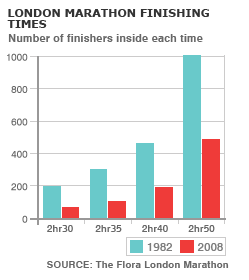
The importance of the London marathon is probably hinted at by the average finishing times in the race. I wonder if you can guess what I'm going to say ? Check this out : here. As the numbers of finishers have grown from maybe 7,000 in 1981 to 35,000+ in 2011 the average time taken to finish the marathon has actually increased ! You'll see in the chart below that the number of 2h:30m runners has fallen by more than 60% over the 24 years. The average time has increased as people like me have been inspired to try and not felt excluded or alienated from the distance. That's the legacy of Brasher and Disley. Accessibly and inspiration. Quite astonishingly by 2009 over 750,000 people have now completed the London Marathon. Many of these folk would never have dreamed they were capable of such an achievement.
So yes, London boasts an elite race capabe of setting world records but it also provides a life-changing opportunity for almost anyone with a basic standard of physical health and the mental determination to see it through. Almost certainly YOU can do it too. The tone of that BBC article is "a good runner but not great" - well I know what they mean. In this blog you've seen my own relative placings from a low-key half marathon with 300 people (Balloch) who were largely dedicated club runners compared with the 11,000 of the Great Scottish Run (Glasgow) - where my position was relatively much higher with a worse time. But that's not the point - look at that last goal Brasher and Disley set for their race. What a superb aspiration. The London marathon is a celebration of what extra-ordinary achievements can be made by apparently ordinary people. If the guy in the ostrich suit can do it ... No seriously - here's a BBC quote from the 2010 London Marathon ...


"Financial analyst Ben Afforselles from Kent was fastest Leprechaun while Kevin Robins from Sevenoaks became the quickest runner dressed as an animal, in a tiger outfit. He said he was racing against a lobster who was also going for the record. "Coming up the Mall I thought he was going to run past me," the 33 year old said"


In fact 10 Guinness World Records were set in 2010 - including (I know this is the internet but this is also true) Sally Orange who was the fastest runner dressed as a fruit (4:32:28). Lloyd Scott competed in the 2002 London marathon wearing a 110 lb deep-sea diving suit. It took him five days and eight hours to complete the course, breaking the world record for the slowest marathon time. Hey Brasher and Disley got their market absolutely right - and Nailed It !

It's time you paused and thought what's stopping me from doing this ? Well maybe not exactly the London marathon - or maybe not yet - but a 5k in the spring is perfectly possible. Stever Runner tells you why in this podcast : it's really worth a listen. It will change your life if you let it.


Lets rattle through some London marathon facts before we look at who's done what.
  • It's likely that 1 in 6 runners will contact St John's Ambulance crews during the race
  • Only 1 in 10,000 are likely to need an A&E referral
  • 60%+ of the runners will be male
  • The most represented age group for both sexes is 30-39
  • Males aged 40-49 are almost 30% of the overall male field
  • Only 3% of runners will finish under 3H
  • 30% of runners will finish under 4H 
  • Estimated number of spectators: 1 million
  • Largest field: 35,694 finishers in 2007
  • Number of people that applied to run in 2010: 162,000
  • Oldest runner: Jerzy Kolodziej 86
  • Most common occupation of runners: Teacher/Education
  • Number of portable toilets: 1,250
  • Number of volunteers: 6000
  • Number of ambulances: 50
  • Bottles of baby oil: 200
  • Amount of vaseline available: 100lbs
  • Number of foil blankets: 40,000
  • Bottles of water: 750,000
  • Pubs on the course: 81
  • Rubbish bags filled after race: 3,450
  • Fastest time in a Santa outfit: 2:55:50
  • Fastest time in an animal costume: 3:42:27 [ostrich]  
  • Fastest time dressed as a vegetable: 3:34:55 [carrot]  
  • Fastest time dressed as a fruit: 4:32:28 [orange] Hey, we know that - Sally Orange !
  • Most linked runners to complete a marathon: 29
  • Most money raised by one individual: £1,841,138
If these guys can (and George W actually did - although not in London) then you can too ....
  • Matthew Paris, former politician and journalist, London Marathon, 2:32
  • Ronan Keating, Boyzone, London Marathon, 4:20
  • Cheryl Baker, Bicks Fizz, London Marathon, 5:19:46
  • Nell McAndrew, Model, London Marathon, 3:08:25
  • Iwan Thomas, 400m Champion, London Marathon, 4:24:52
  • William Baldwin, Actor, New York City Marathon, 3:24:29
  • Will Young, Singer, London Marathon, 4:02:35
  • Muzzy Izzit, footballer, London Marathon, 3.22:36
  • Henry Holland, Fashion Designer, London Marathon, 3:28:50
  • Dwight Yorke, Footballer, London Marathon, 3:31:56
  • Gordon Ramsay, Celeb Chief, London Marathon, 4:05
  • Anthony Edwards, Actor (ER - bald Dr), Chicago Marathon 3:55:40 New york 4:08:20
  • Princess Beatrice, as part of a "human caterpillar", London Marathon, 5:15:57
  • Will Ferrell, Actor, Boston Marathon, 3:56:12
  • Michel Roux, Cleb Chef, London Marathon, 3:59:39
  • Chris Newton, Olympic cyclist, London Marathon, 2:58:52
  • Oprah Winfrey, Marine Corps Marathon 4:29:20

Oprah (on the left)
  • P. Diddy, New York City Marathon, 4:14:54
  • Richard Branson, London Marathon, 5:02:24
  • Amanda Holden, TV type person, 4:18:22
  • Lance Armstrong, Rode a bike apparently, New York City Marathon, 2:46:42
  • David Lee Roth, Van Halen, New York City Marathon 6:04:43
  • Björn Ulvaeus, ABBA, Stockholm Marathon. 3:23:54
  • George W. Bush, 43rd President of the United States, Houston Marathon 3:44:52
  • Michael Dukakis, Former Governor of Massachusetts, Boston MarathonI 3:31:00
  • Al Gore, Vice President of the United States at the time, Marine Corps Marathon 4:58:25
  • Sarah Palin, Former Alaska Governer, Anchorage Marathon 3:59:36
  • Alanis Morissette,Singer, New York City Marathon 4:28:45
  • Eddie Izzard, comedian,ran 43 marathons in 51 days best was 5:00:30
  • Dexter Holland, The Offspring, Los Angeles Marathon 5:09
  • Mike Malinin, Goo Goo Dolls, Rock ‘n’ Roll Marathon 5:07:53 Chronicle Marathon 3:23:56
  • Chris Boardman, former professional cyclist, London Marathon 3:19:27
  • James Cracknell, Former British Olympic rower, London Marathon 2:59
  • Alastair Campbell, Communications Director to Tony Blair, London Marathon 3:53:45
  • Joe Strummer, The Clash, London Marathon, 3:20


So having taken October off completely I'm rediscovering my legs one workout at a time. The goal is for 4 runs this week at very low intensity (did I ever do anything else ?). Then building up to 6 days by the end of November. All nice and easy. Getting the chondroitin, Glucosamine and Elderberry in each day and starting on that core work (yeah right !) . The first benchmark will come in the New Year with a 10k. Join the journey, stay tuned to the blog .....if you dare. Twitter updates between posts: @daretotrilife

Ok, you're right - this wasn't a good idea ...

Tilly : not keen on hill repeats - me either !

Tuesday, 27 September 2011

Running For Sarah : The Half Marathon

The World Record for the half marathon is an astonishing 58min 23s. That's for all of the 21.0975km involved. The time means that Zersenay Tadesse ran each km in approx 2m 46s. Can you conceive that ? I don't even pretend that I'll ever run any km under 3m and consider it a personal breakthrough to run even one single km of a race under 4m ! This is the context. On Sunday 4th Sept some 22,542 runners took part in Glasgow's Great Scottish Run and Kenyan Joseph Birech completed the half marathon in just over 61m. Delighted for Glasgow that the event attracts such a calibre athlete. That's a world class performance and I was privileged to be one of the runners taking part in a world class city half marathon.
Joseph Birech

The choice of the Great Scottish Run was to fundraise £1000 in support of Sarah. I have been overwhelmed by the generosity and warmth of support for her. As of the time of writing Sarah's choice of charity - Northern Ireland Heart Chest and Stroke Association - have benefitted in excess of £1800. A thank-you to all of you who contributed. At the time of writing Sarah is once again receiving care from the Craigavon Hospital staff and the messages of support are and continue to be much appreciated.

There is still an opportunity to support NICHS and the link is here. As it turned out Sarah was joined in Craigavon Hospital by 2 of my Aunts who were admitted for very different reasons. Margaret and Edna are now back at home and we wish them both speedy and full recoveries. All 3 of these special ladies were in my thoughts during the run.

The Sunday morning was bright and blue skyed and the atmosphere in George Square was buzzing. As it always is on race day. The 10k group got under way at 10am leaving the half-Marathon and wheel chair athletes starting at 11am. My employer, Scottish Sea Farms, had offered incentives for staff to participate and fundraise along the way. The group did well and have over £12k raised to date. These are tough times for charities as people have so much less disposable cash so congrats to the SSF staff and families who made the initiative work so well. Now more than ever charities need your assistance. So follow the SSF example.
Scottish Sea Farms : Great Scottish Run Team 2011
I always forget how "bottlenecked" these races can be but 11k people heading through Glasgow can be a squeeze. This year it was almost impossible to even get through the fence to the start chute. The closed roads help but people nearly aways start too fast with too high expectations and by the 1st km many are falling back down the field. The adrenaline of the start line is hard to counteract but 21k is  along way and demands realistic pacing. 
George Square : Glasgow
If you can weave your way through the opening 800m you will eventually have the opportunity to run over the famous M8 and out towards Bellahouston Park and onwards to Pollock Park. By 2k the field had thinned and I found myself with a group I was able to stick with for most of the next 90m.


While my own focus has been triathlon orientated for the last 3 months I have been conscious of giving as much as possible for this race. I know that many older, injured or infirm people would give anything for the ability to run or even walk 10k. Actually even 5k - or in some cases 100m unaided. We simply cannot take our health and fitness for granted. Yes, as individuals we have to work at maintaining our fitness but the freedom, good luck and privilege of being able to simply "turn up and run" is not universally available to everyone. If you can do it - appreciate it, cherish it, work at it, prize it and maintain it. So much quality of life is about movement - if you can walk, run, swim or cycle then "Just Do It !" Think about that and today buy a copy of Runner's World and get inspired. As for me ... well here's the data :


If you want to you can follow the route by clicking on "View Details" as above. This takes you to the Garmin Connect site where you can view the individual km splits (3rd KM is sooo wrong !) ; also by clicking on the green "Start Click" map (when in Garmin Connect) you can retrace my whole race (not in real time thankfully). 

What's the difference between 1h 29.59 and 1h 30.01 ? 2 seconds ? Don't think so. Any runner or triathlete will attest to the importance of certain time barriers. Is a 2:59:59 marathon really just 1 second different from a 3h marathon ? For many people these times are miles and months of work apart. It was important to make this a respectible time. I was running with a purpose and I didn't want to let a very special lady down (in fact on the day I was running for 3). Businesses such as Scottish Sea Farms, Storvik UK, Biomar UK and Fusion Marine had been extremely generous and I needed to acknowledge their support and contribution. People from Northern Ireland like Pamela, Rachel, Jonathan, Michelle and Eoin had felt a connection logged-on and wanted to help. Family in Canada wanted to show their support for Sarah and the charity she adopted. Many thanks to you all for that. So when it seemed a sub 90m half marathon was even remotely possible I had a huge incentive to dig deep and throw in any surges I could to make it happen.

The support of bands through the parks, being sprayed by hoses outside houses and the kind offers of jelly babies or oranges from the crowd helped keep the pace up : 4m13s per km, 4:14, 4:18 all through the 13-15k marks. The Garmin's shrill tone alerting the km splits was a constant reminder. Stay focused. The route descends a little from 17 to 20k and offsets the fatigue. By 20k my surges grew shorter and each more tough to get through. Legs heavier and the runners more sparse around me. Gradually the sounds of Glasgow Green and the finish line were evident - but no visual signs. 4:15 pace though the 20th km. Slower - but hanging in there. Doing this for Sarah. Approaching the 21k the route swings back, narrows and the crowd swells, the hub-bub of the finish line is all around but where is it.?  Where is it ?  21k pace : 4:11. Faster. Doing this for Sarah, for Edna, for Margaret. Don't let yourself down. Now it's 1h 29. 05 ... the pace must quicken. How far now ? It must be soon, surely ... then the joy, the absolute joy of the finish line. There - just there. A surge from somewhere - almost outside of yourself. But there it is. 1:29:35.

To be able to do this is a glimpse of what it's like to fully expereince life. I am proud to dedicate this small effort to Sarah and to those who work tirelessly for others in NICHS.   

Thursday, 14 April 2011

Paris Marathon - The Race

Hi & welcome to the DareToTriLife race report for the 2011 Paris Marathon. An outstanding experience and some lessons learned. First and most important you need to meet my sister Rachel who posted the big news on this trip : she nailed her first 5k run during Saturday's Breakfast Run in a simply stunning location.
Rachel : "Dominating the Dojo"
 Rachel's "couch to 5k" experience, which started after Christmas, was not without drama but she planned it well - took some professional advice & had outrageously pink shoes. Little sister was simply inspirational in her determination to complete the distance. Not sure if she'll stay with running but she set herself the task and she delivered. Respect ! Thursday's trip to Paris via Eurostar was really smooth and very impressive - very easy check-in at St Pancras and with only 10% of the CO2 emissions of a flight. Truly low carbon travel. If you have opportunity to take the trip then do so. 2 hours and you are delivered refreshed, on-time and unstressed to Gare de Nord - right in the heart of Paris. Also you can purchase French Metro passes in St Pancras - so no queuing or language issues when you arrive. The weather throughout the trip was warm, dry and sunny - probably too warm on the marathon if I'm honest and the slower your time the worse it became (24C by 2pm). Hotel Duret (here) was perfectly placed for the race start, finish and local Metro services - it was very comfortable with free WiFi.

St Pancras - Home of Eurostar
A short 6k "recovery run" with some sprints through a local park on Friday morning, then a day spent sightseeing from a "hop on - hop off" bus and an evening's cruise on the Seine. Paris is simply breathtaking whether in daytime or at night. The "City of Light" has one amazing scene after another in never-ending procession. I'm sure a lot of this is to do with Baron Haussman's "free hand" in demolishing and clearing huge swathes of the largely medieval layout of the city in the mid 19th Century.

Paris - "The City of Light"
Haussman, under the patronage of Napoleon III, rebuilt Paris with the grand neo-classical designs that we see today. It makes for a fantastic city break. If you have the chance - save up and go. I'm ultra-serious about saving up ... it's very expensive - in fact it's officially the world's most expensive city to live in. This is, after all, the city of the £4 coffee. But if you expect this (and re-mortgage your house to cope) then you can cram a great deal into a very few days. A 5 day Metro pass is approx £28 - but then you don't need to think about transport ever again. Admission to the Invalides (includes Napoleon's tomb) is about £9 and the Eiffel Tower from about £13. Most of Notre Dame is free as are the wonderful gardens at the Tuileries. Same goes for the Arc de Triumph. We took a Seine boat trip and while it's very predictable and touristy thing to do we really enjoyed it. Paris is a river town after all. The city actually gets it's name from the prehistoric period where the section close to Notre Dame (which is on an island in the middle of the Seine) was a settlement of the Parisii tribe. This riverscape section of the city is a UNESCO World Heritage Site - so don't be mean or elitist, take the tour and enjoy it.


On Friday we scheduled lunch to coincide with Registration in the Expo at Porte de Versailles. As Uncle Ben was sponsoring the "pasta party" it was rice rather than pasta ("they are, how you say, Crazy these French") - but good all the same and the cheapest meal we ate all trip. Banana's from Guadeloupe and Martinique very much in evidence.

The "All Rice" Pasta Party
I think this is interesting : Guadeloupe & Martinique, despite being north of Venezuela, are severally one of the 27 regions of France and considered an integral part of the Republic - even returning Deputies to the Paris National Assembly. They are legally a part of the European Union and for each the currency is the Euro. This seems much in contrast to the UK's approach to former Dependencies. The Expo itself was substantial - with it's own triathlon section (for the enlightened). All the major shoe manufacturers were represented with Garmin and Polar etc etc. All you could wish for and more. There was an important Guide booklet given to us at the Expo. I did check out the course details and for the 1st time noted that there was only 1 energy drink station - all the others would be water / oranges / and ... banana's. This should have prompted me to think but it didn't. All my long runs have been based on energy drinks taken out of sequence with gels. I had the required gels - but none of the energy drinks. I should have immediately dropped all and bought a Camelback and hunted down some Gatorade - but I didn't. Would I regret that ?
Interior of the Dome at The Invalides - Napolean's Tomb

It's now Saturday morning. So having been in Paris all of 1.5 days if we we're gonna eat breakfast we'd have to run for it ! The allure of the Breakfast Run was ... free coffee. Using the trick from Barcleona of sticking my metro ticket under my trainer insole we set off and made the venue in good time. Rachel was very nervous about her début but as always the gathering group was very friendly and very inclusive. Runners are of all ages, abilities, shapes and sizes. In a mass-event like a marathon with 30k+ runners it's as far away from a "club" runner mentality as is possible - which is great as far as I'm concerned. This is more about celebrating a lifestyle choice than refining athletic skills - although there's a place for that too. The Paris Marathon Breakfast Run is a very non-threatening and encouraging environment - people were glad to be there and the weather was excellent with blue skies. But you have to run one to know this so Rachel's nerves were understandable. A few folk were in fancy dress - a gang in Hawaiian grass skirts, a spiderman - some milkmaids etc.

A taste of Hawaii - in Paris !
The 5k route was run over closed roads and in-front of the Eiffel Tower - so that's a lovely memory for a family member attending in support of a marathoner. It was low-key, no-fuss and a worthwhile final workout ahead of the main event. It also ended in exactly the same place where the marathon would end - which was a nice touch for those taking part. There was coffee - but what I'd consider to be "breakfast" was notably absent - no bacon, smoked salmon or scrambled eggs - just coffee, those banana's again and a sponge finger. . Hey folks - it seems even the French don't eat enough salmon !
Moulin Rouge - I didn't go (honest)

For the rest of Saturday we rejoined the Hopping On/Off Bus and took a route south then north of the city centre. To the north is a slightly seedier district characterized by the Moulin Rouge and other "entertainments" it's an area of the city which includes the Sacre Coeur. To be frank we were getting "all cultured out" by this stage and glad to wander home in search of a pasta restaurant.

Sadly the expected Pasta joint was closed and we ended up with a sea bass some French beans and a salad. I think this was a mistake. Despite emergency sandwiches, isotonic drinks and fruit bars I think I should have had a few more dense calories. Having said that there were no "digestive" issues on the run so perhaps there's something to be said for the lighter meal. I know I'd go looking if I had the time again. Loaded up 6 gels onto the race belt. Layout clothing options, check the on-line weather forecast. Sip isotonic drinks. Fitful sleep. Apprehensive. Excited.

Race Day. Up promptly thanks to Stephen's Tweet - he's back "in the world" and will deliver an outstanding sprint-triathlon PB in Fife later that day. Meanwhile I munch on sandwiches and down an isotonic drink. Hotel kindly makes a coffee and adds another £4 to the bill - nonetheless the buzz is welcome. Add metro ticket and €10 under the trainer insole - just in case of emergencies - and meet with Rachel in reception. She's bouncing - I'm terrified. We have post-race clothing to drop off at the finish and already there are folks on the street heading in that direction so, like sheep, we follow dutifully.

Arc de Triomphe on race morning
The connecting avenues are a sea of marathoners in their plastic thermal wraps ; control of the Arc de Triomphe wrests from chaotic vehicles to walking runners making their way to their designated start at the Champs-Élysées. The atmosphere is upbeat and fun. Club groups are having their photos taken under the Arc de Triomphe and the positive mood is matched by the weather : warm morning sunshine and blue skies. Commentary in French and English counts down the start for the wheelchair race.

So here's the deal : you are seeded by your estimated target time and I had aspired to 3h - so you enter a side pen to join your group. I said my goodbyes to Rachel and entered the race start only to find I was in the 3h:30m section - so a battle took place to move forward. Eventually I came to a halt at a barrier and was content to stay with the 3h 15 group. It's a ChampionChip race so your own race time only starts when you cross the "Depart" line so no worries. The announcer calls for a moment's silence for the wider "family" in Japan - nice touch and it was well observed. No time now. The wheelchair athletes have left and it's moments now until the start.    

You will have seen the Champs-Élysées many times if you follow the Tour De France. On the last day the Tour returns to Paris and while the Yellow Jersey has been decided the "King of the Sprint" title may remain available. I think 6 laps are contested by the Peleton. So we often have this image of the scene ....
While on Sunday it looked like this ...

.. as 32092 runners aspired to conquer the 26.2miles. This many athletes is overwhelming - the "personal space" needed to be safe let alone maintain a target pace demands constant attention. It's therefore very important to start in the right pace zone with runners of similar ability. It is a descent from the Champs-Élysées to the Place de la Concorde and as it's an adrenaline-fuelled race start the pace is fairly fast. The avenues start very wide but gradually narrow on the Rue de Rivoli. To be honest I was far more aware of the architecture in Barcelona than in Paris - one's attention had to be on the road and on those runners close by. Despite this I did actually clip someone's heels at one point and sent him reeling - thankfully he stayed in control and no harm was done. It was possible to run on the pavement in some places and that helped the congestion. I don't think this really damaged my time it just took extra focus. Here's the route :


Much of it is surprisingly suburban in character especially after the Place de la Bastile. Crowd support was generally strong and in places the roads narrowed and the noise  from the crowd was overwhelming. At these occasions it was possible for supporters to read the name on your race number and I had a couple of "Allez John" calls - which were great. Also it always gives a buzz when you see the Union flag. The second half of the race follows the edge of the Seine and descends into several underpasses - which means the Garmin lost the signal. Some of these "subways" are quite long - maybe even up to 1km. These looked familiar - again there is a part of the Tour de France where the cyclists disappear unto a long tunnel - I guess it's the same course. The overall course profile (in metres) is below. You can see it's fairly flat throughout. The day became warmer as the hours wore on and a real blessing was being hosed down by volunteer firemen along the route - although I'd forgotten about that metro ticket in my shoe. It was so soaked it choked up a Metro station machine hours later that afternoon. Thankfully sister saved the day.


So how did it all workout ? Well my "take away" feeling is it should have gone better. Looking at the splits I was almost 2 mins ahead of Barcelona (March 2010) after 5k and 4 mins better at both the half way and the 30k mark. Then somthing of a collapse in the last 10k losing 2mins to end up with a time of 3h 13m : 31s. This is approx 3secs faster per km than Barcelona. Yes, I'm a year older but this was a higher intensity training plan and the lead in races have all been suggesting a time closer to 3:10. In truth the last 10k were no fun and just had to be "ground" out. I think there's 2 possible issues. Perhaps not pacey enough long runs : maybe the trail runs were too forgiving and I needed to cover more like 40k than 37k in that longest run. Or the nutrition didn't work out. I think the latter is a definite possibility. I used a gel with every 5k water stop so had used 5 of the 6 by the 25k mark. I expected to skip the 30k gel waiting instead for the Powerade at the 33k mark. As it turned out this was probably too little given what I'd been using in training (gels and sports drinks). The heat may have played a factor too and I was lucky to have taken a cap - which could be filled with water at the sponge stations. But the memory is of low energy in that last 10k and a wearing fatigue - it was almost impossible to raise a short interval of faster intensity. It think the Garmin data below shows the drop off in pace quite convincingly.

A few hundred miles further west Tilly was showing her support by a marathon effort all of her own. 4 circuits of the garden adds up to 26 "puppy" miles - as you can see she left nothing on the course.
So where does that leave this experience ? Well the important thing was to be there when my sister achieved her landmark. I'm delighted by that. The trip exceeded my expectations on every level except the race itself. I think it's a mistake for the organizers not to have had more energy drink stations (although they had loads of water for keeping cool) and they really must make it clear on the website if energy drinks are limited to one opportunity (for the sake of travelling runners). I checked what Barcelona had done and every aid station there provided the choice of water or Powerade. The thing that most surprized me was despite the modest improvement in PB there was a huge improvement in ranking. I placed 815 of 8937 males in my age group and 2116 of 31169 overall. This is a much higher % than Barcelona.
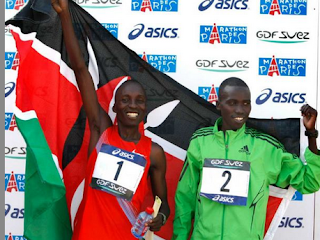
Benjamin Kiptoo, 31, of Kenya won the race in 2:06:31
So after 20 weeks of training through a pretty tough winter was it worth it ? Well Benjamin has nothing to fear that's for sure. But "Yes", of course it was - and the beauty of a nutritional problem is that it can be easily resolved. It was a privilege to take part in such a massive race on such a beautiful day in such a magnificent city. The people we met in Paris were friendly and warm - much different from the British popular stereotype. The city is extraordinary and if you have the chance you should go. I'm not sure I'm sold on these vast fields of runners but the crowds and city-scape is something I will never forget. It was a great and successful trip on every level. Had I got closer to 3h there would have been the temptation to drop this distance. But now... well I've improved, and I just lodged my 6th attempt for London. That would be for 2012  - Olympic year - Hey, Wouldn't that be something......


To Be Continued.       

Monday, 4 April 2011

Scottish Duathlon Championships : 27th March

Men came from the West (in tights). They travelled long and gathered at Stirling to compete at the highest level. They had worked hard through the toughest of winters. Struggled through adversity. On this cold morning they laughed in the face of British Summer Time and ate bananas. 5 Veteran Males that between them took the 19th, 20th, 22nd, 25th and 27th places in their age class. If only we'd chosen these as our lottery numbers ! Find out more as I (briefly) escape from the darkness of marathon training and into the welcoming light of multi-sport. 

The day was crisp, cold with only a light breeze. Most of us chose to travel from home early that morning with encouraging text messages exchanged. This was a 10k run : 37k cycle : 5k run format and it was the 2011 Scottish Championships. The big news for us was that we'd be competing in the same race as 2010 ITU Duathlon Champion and 2010 Ironman Lanzarote Champion Catriona Morrison. In truth I didn't really see much of her : she was 5 minutes faster than me over the 10k and another 8 mins faster on the bike. Superstar. So the Argyll group met with about an hour to go - Matt and Tim were deep into bike assembly and Stephen had already registered. I think all of us were keen to know what the others would wear but no-one was saying. The tights stayed on. The Stirling Club hosting the event run a children's race just before a duathlon-sprint distance which in turn is ahead of the Championship race. There are teams as well as individuals - which makes the event very inclusive. Eventually with 10m to go I undertook a short warm-up jog. 
Last weekend was the big mileage week in my marathon plan. The Sunday long-run turned out to be a 37.2k trail and road-run taking just over 3h. I was happy with the run at the time but it took a few days to recover from and the 45 year old knees were complaining - for the 1st time in this whole Paris Marathon campaign. So the warm up was somewhat creaky. You know what ? I don't think I'm eating enough salmon. Anyway it was decision time : tights to stay, long sleeve technical top is selected, light gloves and the Triathlon Scotland buff. The worry was how cold it might be on the bike. The 5 amigo's line up with John looking intense and dangerous, Matt already looks in pain (and we haven't started yet), Tim is zoning in and Stephen is winding us all up. The moment we start, and Cat Morrison disappears from view forever, the sun comes out and the men-in-tights are suddenly way way over-dressed. The crowd of runners surges forward and you get the impression that this race is at some "other level". On the same day Kelownagurl (Kelownagurl Tri's podcast : here) was running a half marathon in British Columbia and she observed that the quality of the field was far superior to her last outing of the same distance last summer. I guess she concluded that only "serious nutcases" would be training through the snows of winter for a March endurance event. I think she got that dead right. These particular "nutcases" were running past me in droves. John was close by, Stephen some way ahead already and Tim & Matt a little behind. About 500m from the start you hit a sharp incline :

A sharp incline - 4times !
Matt : no chance of frostbite here !
This is not funny. It's narrow and single-file going up. It's simply hard work. I think I got to the top just ahead of John and this set the pattern - for some reason I was able to cope with the uphills while he unfailingly overtook again on the downhill. This made for 2 very different race strategies. John has obvious skills from his orienteering background and it showed. Stephen had 300m into us by the first 2k and thereafter it was an occasional glimpse of Tim & Matt as we ran the 4 by 2.5k loops to complete the 1st run. By then it was obvious that this was a "full-on" event with very classy competition. It was also obvious that John and I were in some former life deeply conflicted Siamese twins. On the last descent (9.5k in) John really took off & opened a serious gap which I struggled to close. However as he approached T1 he started to prepare for the bike and lost a little momentum. I pounced ! We both crossed into T1 at exactly the same time. My T1 transition was only 7 seconds worse than Cat Morrison - how good is that ! You are also struck by how uncluttered T1 in duathlon is compared to triathlon - not a wetsuit in sight.
Tim - "in the zone" and taking out "324"
My beloved Specialized in hand I leave T1 ahead of John and get away fairly cleanly. I have no clue where I'm going as I haven't pre-driven the route. Fingers crossed. In no time John is powering past and looking really strong. Surely I have more to offer than this ? Dig in and try to get a rhythm going. The bike is responsive and seems to be flying. The route is like a ring-road connecting villages to Stirling. The surface is excellent and I'm hugging the painted white edge strip where I can. John is up ahead and closing on another competitor. But actually beyond this there are not a lot of cyclists in sight - they are long gone. I try to get the best line I can across the many roundabouts (this is a open road event) and note that I seem to be closing John down. Eventually this happens and we cross for the last time. The Garmin chirps every km and I'm pleased with progress. I make it through the 1st circuit and start final cycle loop. At 23km a real prize looms. "Yes" - those tights were a giveaway - but the number 400 confirms it. Stephen has been reeled in ! It takes real effort to get past him and we exchange supportive comments. I have to confess the next 10k are spent trying to work out what possible lead I could have as the second run starts. Deluded or what ? Context is provided by someone with solid carbon wheels who cruises past as if I were travelling at 20km/h instead of the 32km/h I was, until then, so proud of. It wasn't until later that it was suggested this might have been someone in a team - regardless it certainly showed a different level of cycling skill. Back to the drawing board.
In the distance I think I can see the uber-cyclist and have a sense of closing down some distance. However as I turn off the main road and back onto the University grounds it becomes clear this is an entirely different person ! Approaching T2 I somehow managed to get stuck behind a bus slowly trundling through the campus - which was deeply frustrating. T2 went smoothly but on leaving transition the legs feel characteristically heavy and dull - despite having stretched on the later bike descents. In utter horror I can glimpse Stephen arriving at T2 and figure I have a lead of maybe a minute. Over 5k that's a cushion of 12 secs per km - I realize the game's up.  I fully expect to be overhauled by the top of the slope but that doesn't happen. He's gaining - for sure - but even Stephen might be human. My 1st 1k was at 4:40 pace but the second was at 4:20 - which I'm pleased with. However the inevitable happens at approx 1.5k as Stephen powers past and he seems in great shape. There's no way I can go any faster so I just need to focus on my own race. It's impressive all the same. At around 1.8k you double back and have a chance to see those immediately behind you. John is there and looking characteristically solid and well within himself. Matt is next and urges me to try to catch Stephen but there's no way that will happen. Next is Tim - running with super form and clearly well on his way back from his injury. These are great guys and I think all of us took something worthwhile from the event. Tim's 1:10:01 for the cycle was testimony to long long hours on the turbo. Beware Mid-Argyll triathletes "The Force" is suddenly with Tim. I enjoyed the great food and the debriefing in cafe afterwards but what's with the fixation with my Planet X 50mm carbon wheels ? Hey guys, haven't you heard ? ..... it's not about the bike ! 
Following the duathlon our combined run distances (9 miles*5Aged Veterans = 45 Miles !) was dedicated to the Run for Japan Red Cross Appeal : see here.  It's no too late for you to do the same.    

Men In Tights (from the West)
While this was, of course, an exciting way to spend a Sunday the real drama of the week came the day previous. This was the day we travelled to Dumfries and met Tilly for the first time and while we've yet to have an unterrupted night's sleep since she came home she is utterly wonderful and such a welcome addition to our lives.  Not sure this view is shared by our two cats (Beazley and Squill) but hopefully they'll increasingly tolerate the "new arrival". Tilly is a Flat Coated Retreiver with razor sharp teeth and a very wonderful personality - I can now assure you it's not just tigger's who's bottom's are made out of springs. Dearly Beloved is attempting to train me not to lead this poor dog astray and to have a "confident, stable, assertive and serious demeanour" when I interact with Tilly. What are the chances of that I wonder ? Oh well, if I'm good maybe I'll get a biscuit too ? Hey what's the GI rating of dog biscuits ?       
              

Friday, 3 December 2010

DareToTriLife Book Club : Brain Training 02

So folks how did you get on with the opening chapters ? I guess I have a confession to make. I have followed training plans by Matt Fitzgerald for both Ironman and marathon distances so I think that helps me understand his approach and concepts (and some keywords) a little easier. I also trust his judgement and right now I am using his plan for Paris in April. The foreword was hardwork - skip it.


I think it helps if you have some key words into your head : Base runs or Recovery runs - low intensity often low-duration aerobic runs at moderate pace. Endurance runs - these start at moderate pace over longer distances but gradually build towards race pace as a race approaches. Tempo runs: Matt is keen not to endorse the long held view of an "anaerobic threshold". For him Tempo runs are runs taken at 10k or half marathon pace. Cruise intervals are a Tempo run with an active recovery (low intensity) break in the middle - also done at 10k pace. Intervals - short high-intensity segments followed usually by an active recovery low intensity segement eg. 30s sprint with 2min active recovery jog. OK, we got that over with.

So all that said what did I get from these opening chapters? Well you get a big clue from Matt's lack of focus on heart rate, or anaerobic threshold and he's quite dismissive of lactic acid as a driver of fatigue. I think he wants us to focus on our aspirations ... maybe you dream of a 50min 10k or a 1h 45m half or a 3h marathon - or whatever. Matt would encourage us to set realistic near-term goals based on testing your present fitness. This gets our ultimate goals into perspective and from that viewpoint we use a scientific pace-based approach to improve. Oh, and Matt wants you to hurt - but in a good way. A planned, controlled and scientific way. In fact he's very keen on the promotion of gym work, cross-training (resistance training, flexibility training, non-impact cardio training : eg. a bike). This "hurting" thing need not put you off - this is not a book about multiple desert marathons or heavyweight sacrifice. If you're reading it you'll probably want to improve from whatever level you're at today and that means you'll need your body to adapt to new stresses that you'll impose during training. That inevitably means pushing yourself and the "hurt" is inevitable - but so worth it.

Courtesy : Salvatore Vuono

The idea that my brain could be holding back my performance rather than some imposition from lactic acid induced muscle fatigue was interesting & I think it very persuasive that the brain is likely to have it's 1st focus on keeping the body's systems ordered and controlled as it ensures stability (homeostasis). So Matt dismisses energy depletion as the cause of fatigue, he gives the brain a slightly "sinister" role through an ability to control your race performance based on it's assessment of your fitness level, past experience, environmental conditions etc (teleoanticipation). He quotes a powerful example of this with high-intensity interval training where athletes ran the last interval of a series of demanding sessions no faster nor slower than the earlier intervals. Somehow the brain had managed things to be able to control how the muscles would perform for that last interval. If you have a Garmin and you've done any intervals you'll relate to that. Just how was your body so able to keep that last interval's performance in reserve ? Spooky eh ?

Matt very positively states that running form can be improved throughout your running life, and that strength training is vital. It was interesting to learn that top-quality runners are actually using a higher proportion of their muscle fibres than someone like me. Matt suggests that early in a training plan maximum speed (sprints) could be employed (carefully) to recruit new muscle fibres which can then be used throughout later weeks. That's certainly new to me & I need all the new muscle fibres I can get. I think he's on the money there. A major thrust of this book seems to be about training with a focus on pace (min/km or min/mile). It's as if we cannot trust heart rate & Matt hardly mentions it in Chapter 1. There's a strong focus on 3 feedback areas (Feedback Loops):

1. Collective Feedback Loops

Stuff & help we get externally :
  • training guides
  • injury prevention methods
  • advice on the correct shoes
  • what nutrition works best (for you)          
Run ....a lot. Want to improve running performance ? Increase running volume. BUT focus on running form. Matt uses the term "proprioceptive cues" and I so wish he hadn't - I can't even pronounce it. But his training plans make clear what he means : "driving the thighs" or "feeling symmetry" or "falling forward". Matt wants us to develop a self awareness of our form and create a mindset of what better technique might look like & hold that mindfulness throughout a workout. Very Zen.

Progressive change is emphasized as you progress towards your goal race. Base through to Peak phases each with a need to focus on slightly different aspects of your fitness. Matt talks about Key Workouts : the quality workouts that need to be a part of any plan. These are : speed workouts (gets those lazy muscle fibres firing), intensive endurance workouts (experience of race pace) and extensive endurance workouts (experience of race distance). In addition : Breakthrough workouts : these are often races you take though your training period where you absolutely "smack it". Max effort - Full on. Zero left in the tank. Matt emphasises this as it will familiarize the brain with pre-race nerves, race pain and suffering. Have you ever seen Matt and Coach Troy in the same room ?

2. Objective Feedback Loops

The goals. The data. So ask yourself ...what are you training for ? To what do you aspire ? What do I want to achieve in this workout ? While Matt defines your true performance limit as "the fastest pace you can sustain over the full race distance without literally killing yourself" it is a reassurance that the brain will never let that happen. However he makes the point that people race faster when they race against folk of a similar ability - in other words the brain lets you raise your game if you really need to. Having time goals - or pace goals - in a workout is a great way to ensure you deliver improvements in performance. Be demanding and have high expectations of your body. But be careful. You will not go from couch to Chrissie Wellington in 6 months (she is 15m up in IM Arizona as I write). A well chosen goal is one you think you can do but are not certain you can do - and it is grounded in where you are now. A 50min 10k might take you 3 years, improvement built on improvement, to achieve. But that makes the goal no less desirable. Departing from the text here there's a resource that's very helpful in this respect.

In this table by Jack Daniels you can determine your own "VDOT" level. Don't worry what VDOT means. Just imagine you have a recent 10k time of 54m. That equates to a VDOT value of approx 36. This helps you in 2 ways.


  • It allows you to project that at this level of fitness you could run other distances in certain times eg. a VDOT of 36 should be capable of a 2h 01m half marathon or a 4h 10m marathon (if you trained for these distances of course).
  • It also enables you to predict training paces that you should be working-out at. 
So lets go back to what Matt was saying about interval running or endurance runs. What pace should you be training at when you undertake these sessions ? Daniels took the VDOT level and suggested supporting pace values as follows.


Lets say our "VDOT = 36" athlete has an "easy run" for 40min. Daniels' suggested pace is 6:38m/km but if the session involved several 400m intervals (say on a running track) then each interval should be run at 2m 02sec pace. The value of this table is immense. Not only does it show you where you should be training right now but it points to where improvement will come from. Our "VDOT = 36" athlete has a goal for a 50m 10k. On our 1st table this needs a VDOT level of 40 (see the arrow). So the athlete must transform themselves from a "VDOT =36" to a "VDOT = 40" level of fitness. That means Tempo runs (approx race pace) at 5.06m/km (red arrow above) and track interval sessions of 1m 52sec black arrow above). So the athlete has a clear vision of the standards required and the route to get there. In Matt's "brain world" we have a scientific way of setting the sub goals to reach our ultimate target and each workout is an end in its-self. Not surprizingly all this goal setting and structure lends itself to recording your progress and the setting up of training logs. These allow you to review and keep motivated. Find a free electronic one here and Matt himself produces a paper based version (below).  If you'd like to know more about Jack Daniels try here. Matt writes " Pace based workouts are one of the the most important and unique features of the brain training method. The whole systems is orientated toward the goal of convincing your brain that you can sustain your goal pace all the way to the finish line of your next big race..."


 3. Subjective Feedback Loop

The feelings & emotions of how you feel during the workout, during the race or during recovery. Listening to your body and knowing when to do more & when to back off. Matt suggests that there are 5 ways to use subjective feedback :
  1. Responsive Training - do the right workout for your body & don't slavishly follow the training plan. When you unexpectedly good - go harder & be prepared to take a day off when you need it.
  2. Heeding Pain - stop running before the pain becomes severe. Review the training log to see if there are clues.
  3. Run by Feel - the self awareness to exactly the right thing in that precise moment. If you perceive your effort correctly you will know if there's more to give or if it's a time to hold back. I personally think that heart-rate is helpful here - if you know you have a little more to give then it can give you the confidence to "go for it".
  4. Control your Form - how am I moving ? Where is my foot striking ? Am I over-striding ? Teach your body what "good" form feels like and develop the self-awareness to reproduce those feelings as you run.
  5. Positivity. Focus on those thoughts and emotions which will help your performance. If you have a GPS then focus on the mile/km splits. If you're ahead great, if it's not your day then re-define your goal and get after the new one. You could even get into visualization. Lets break ...

      
    Yip, it was sure time for a break. Great kid eh ? What does your morning affirmation look like ? Hope it looks somthing like Jessicas.  Matt's Chapter 2 is a little bit like "the knee bone's connected to the thigh bone, the thigh bone's connected to the hip bone ..." etc etc.

    He talks about the structure of the brain. Neurons are the active brain cells that make stuff happen. They communicate and are very "plastic" i.e. they change their function as you do new things - so if you learn a new skill neurones adapt to enable you to do it. Neurones formerly involved with vision can adapt to become involved with hearing in a newly blind person - they are that flexible. A physical experience is a fusion of millions of neurones firing away to create an "activation pattern". The more that activation pattern is repeated the more neurones change slightly to make the impulses easier, faster and more precise improving communication between neurones. Essentially it all becomes more efficient. This is why a new learned behaviour becomes easier over time. The brain then connects outwith itself - to the muscular, sensory, digestive and immune systems. It sure keeps busy. When you run Matt considers the brain is at work as follows :
    A neurone : courtesy jscreationzs
    1. Motor Output - activating and coordinating the muscle groups involved. This is mindblowingly complex and even extends into how the tendons and muscles store and release energy gained from the foot impacting the ground (giving you more forward thrust).
    2. Stride Adjustment - taking account of the terrain and your body's 3D position in space. Are you running uphill, over loose surfaces, is it windy,what was the consequence of your last stride ? While most of this is thankfully sub-conscious it is possible through self-awareness to consciously adjust your stride to improve form.
    3. Metabolic Regulation - when you run fuel-demand in the brain, working muscles, the heart and the respiratory system all massively increase. The brain recruits the optimal number of working muscles given the oxygen volume that the runner can supply and the available fuel supply. It also controls the release of that fuel into the blood stream. 
    4. Perceived Effort - this is hot. Feelings of fatigue might well originate in the brain & not the muscles. The brain might generate feelings of discomfort, pain or reduced motivation in order to slow the runner down.
    5. Thought patterns - at relaxed, controlled efforts the brain's frontal lobes exhibit an alpha-wave pattern - where thoughts are often random "flows of consciousness". However where the runner is very focused in a race situation - or in the achievement of an interval pace -  Matt describes an "in the zone" state-of-mind where there is very low frontal lobe activity and a real polarization of brain activity into those areas directly involved. The runner is "not thinking; they're just doing".
    6. Focus. The ability of the brain to hold focus on the "total experience of running" rather than allowing your mind to wander onto other matters - staying in "the moment". 
    While the above are brain-controlled interactions that take place during running the act of repeatedly training brings brain adaptation as follows :
    1. Regular motor signals being sent to muscles increases the number of motor units that the brain uses. More motor units = more muscle activation = more force from your stride. Also the brain rotates the muscle fibres it puts to work at any given time - resting some and working others. More motor units = more fibres available to be deployed = more rest before a fibre is re-used = more endurance.
    2. The repetition of training leads to improved neuro-muscular efficiency - enabling more speed from less muscle activity. Part of this is technique based - involving fewer muscle fibres by more forceful contractions.
    3. Delayed fatigue - the body becomes conditioned to a lower blood glycogen level and the muscles and liver become better at glycogen storage.
    4. Increased Self-Belief. Training brings psychological benefits - knowing in the race that you've done the "hard yards" in training. Knowing you are "ready".
    5. Cardiovascular exercise in it's own right stimulates neurone growth and and strengthens interconnections. It improves focus. Exercise lowers the risk for and slows the development of dementia and Alzheimer's disease.  
    So how did you get on ? - for me this was an excellent opening to the book. I had a glimpse into the complexity of running physiology and a feel for how Matt is going to develop into the huge number of training plans that make up more than half the book. I especially liked his focus on my goals & his challenge that potentially I'm the barrier to my own success. Of course if I know that I can change and improve. The message is hopeful and full of promise. Please drop a comment in the box on your views - what worked for you ?